The Anxious Narrative
A critique of the social media panic and a defense of intellectual honesty.

There’s a particular kind of intellectual trap smart people can build for themselves. You stake out a bold position. You write the best-selling book. You do the TED talk. Your speaking fees rise to the tens of thousands. You get to appear before parliaments. You become the guy on the thing. Followers flock. But then, slowly, the evidence starts moving in the wrong direction. At that point, you face a fork in the road. You can follow the data, or you can double down to protect the narrative. In essence, you start lying to yourself and the general public.
Linus Pauling, for example, was a two-time Nobel laureate and was genuinely one of the greatest scientists of the 20th century. He became convinced in his later career that megadoses of Vitamin C would cure cancer and the common cold. No matter how much contrary evidence mounted, he selectively cited supportive studies (as many of us do), dismissed negative findings, and co-authored papers increasingly rejected by mainstream journals. His public stature meant the idea persisted for decades despite the evidence. The more celebrated you are, the more confirmation bias costs everyone.
It’s at this stage of one’s career that we require epistemic courage, or we risk becoming a leader with many followers, playing the Pied Piper and leading them with a deeply compelling story evidence no longer supports, if it ever really did.
The Pied Piper is a fitting metaphor because the danger is not simply that a persuasive figure leads people somewhere. It is that a frightened and worried community is willing to follow a simple, emotionally satisfying story without demanding enough evidence to determine if we’re going in the right direction. Now, I understand why parents and educators are concerned about technology and social media. New technology scares many of us, and adult humans are far more resistant to change than we think. So, while reading this, I hope you understand that I’m approaching this purely from the perspective of how we can remain evidence-based in our decisions about social media and smartphones.
In the case of the Pied Piper, children’s well-being has become a moral currency that makes dissent feel irresponsible. Policymakers and concerned adults follow the tune of a technological moral panic, and the tragedy of the Piper is also a warning about consequences: once a community hands over its judgment to a compelling narrator, it may not notice what has been lost until much later.
The Anxious Generation
I want to be generous here, because I think Jonathan Haidt cares about kids. The Anxious Generation told a persuasive story that resonated with many adults. But many clever tricks were implemented to help massage shaky science into rhetoric. The first trick was labeling an entire generation. This happened before with the coddling of the American mind. Everyone was coddled, and then everyone got anxious. Smartphones and social media played a role in both of those stories.
I use the word “story” here - or “narrative” - because Haidt is a great storyteller. Graphs help you to tell a story (more on that below). So do pictures of children playing on less risk-averse playgrounds from back in the day. For example, here is a 1970s-era playground in South Australia. Look at all those kids playing outside doing dangerous things! Not an iPhone in sight! Where did this childhood go?

I’ve spent this year being the guest on dozens of podcasts, radio shows, and small local news TV spots promoting my latest book, Kids These Days. Every interviewer eventually comes back to Haidt and the smartphones. He has created a collective consciousness that social media is harming children, and politicians are leaping to take the cheap political win. The problem is, there have been and will be real consequences to legislating a bullshit narrative. One of the most common findings I’ve heard from parenting coaches and therapists is that The Anxious Generation has had one clear result: parents are increasingly anxious.
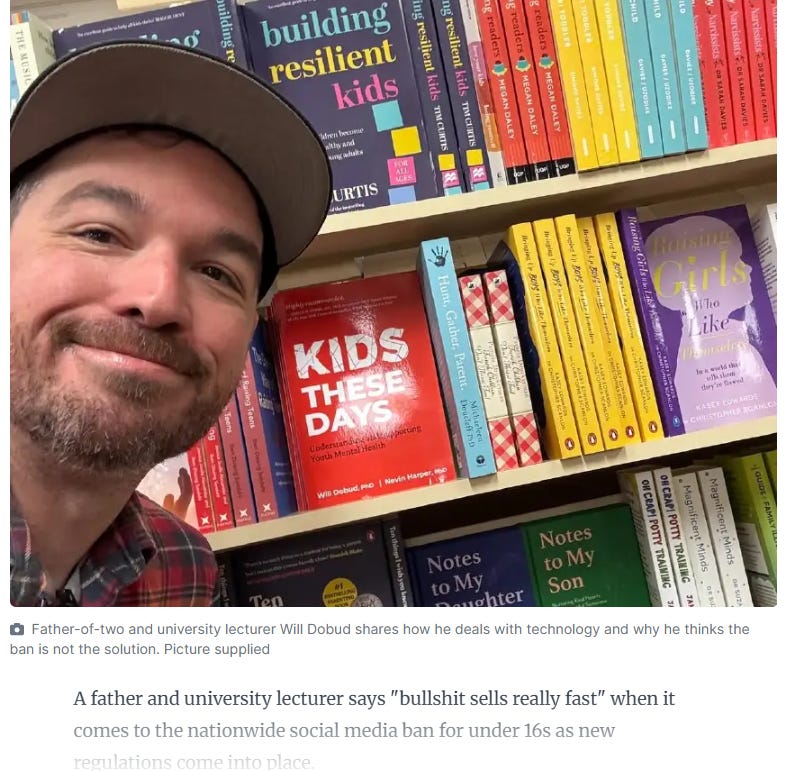
Last week, I was quoted in Australia’s Daily Advertiser discussing the social media bans now that we’re over six months into this. Unfortunately, the full article is behind a paywall. You can read the first line of the article in the screenshot below and get an idea of my feelings about the bans.
Later that day, I saw a post on X/Twitter from Jonathan Haidt. He wrote, “The Australia social media law is off to a good start.” He then told a joke, as follows:
“As Lao Tzu said long ago: “A journey of a thousand miles begins with a single step. But if that first step is hard, then you should quit.”
Actually, I think Lao Tsu only said the first part. The second sentence was added by all those who are saying the Australia law has failed because the first step did not bring them to the final destination.”
First, the ban has not worked and is no longer viewed all that favorably. Even Australia’s eSafety Commissioner acknowledged such (again more on that below). It was a shoddy political gesture, drafted in just over a week, that is now mostly considered a waste of time and emotional energy. I spent last week in schools, where kids laughed at the ban, and teachers said, “No one cares anymore.” Nearly 80% of kids are still on social media, and recent research “found the more young people are impacted by the ban, the more likely they are to report they are getting less news and having less opportunity to discuss news and the issues that matter to them.” In Australia, knowledge of civics has reached a 20-year low, so not accessing the news is a problem. Additionally, many disability advocacy and human rights groups remain opposed to legislated bans that restrict freedom to information and communication. So despite what the data shows, Haidt claims things are off to a “good start,” and we’re wrong to oppose the ban just because it’s “hard.” But this wasn’t data-driven from the start.
Caring about children and being right about the cause of their suffering are two different things. And when you’ve been the intellectual engine behind Australia’s world-first social media ban, the UK’s similar ban, the phone-free schools movement, and more, it matters what you do next.
First, let’s look at the data informing all of this.
On Getting It Wrong from the Start
When you stack up what the systematic reviews and meta-analyses actually say, the picture is far more complicated - and far less alarming - than Haidt’s central argument. And we now have so many meta-analyses and reviews that we've probably done enough research to really start settling this discussion. After all, the meta-analysis was invented to settle scientific debates, if that’s ever really possible. A meta-analysis is the study of studies. The difficulty with this discussion, when it’s brought to the Today Show (no matter what country you’re in), where you get 1-2 minutes to share your talking points, is that the data doesn’t care about our feelings surrounding social media and youth mental health. I’ll examine a few.
A 2020 meta-analysis across twelve studies found only a small correlation (r = .11) between adolescent social media use and depressive symptoms, with extraordinarily high heterogeneity (I² = 95%) across those studies, indicating that something other than social media itself was driving the variation in findings. These are all statistical numbers that are challenging to interpret when not all of us are statistical geniuses, myself included.
To provide a crude metaphor, a correlation of 0.11 is like being blindfolded in a helicopter and trying to predict the exact elevation of the landscape directly beneath you. Your method for predicting this altitude is to toss a coin. Every time it lands on “heads”, you guess the ground is slightly higher; every time it lands on “tails”, you guess it’s slightly lower. Mathematically, a coin flip gives you a tiny fraction of a percentage of predictable accuracy, but in practice, you are essentially just guessing. A correlation of r = 0.11 shows certain variables are technically linked by the thinnest thread, but that link is entirely useless for making meaningful predictions in the real world. To be cruder, this is the square root of fuck all.
A larger 2022 meta-analysis collected data from 226 studies from over 275,000 people found that general social media use had essentially no association with combined well-being (r = .01, non-significant), with only small significant effects for anxiety (r = .13) and depression (r = .12). The authors described these effects as modest and heavily moderated by research methods, geography, and type of use.
Now we get to the review of the reviews. A 2026 umbrella review synthesizing 72 reviews and 20 meta-analyses published between 2021 and 2025 found that general social media use showed “weak and inconsistent associations” with both well-being and ill-being, while only problematic social media use - a fundamentally different construct - was consistently linked to poorer mental health outcomes. In other words, what the evidence actually supports is a targeted concern about compulsive use in a subset of young people, not a blanket case for banning all under-16s from platforms. The distinction between use and problematic use is not a minor methodological quibble.
Consider, too, my colleague Christopher J Ferguson, Ph.D.’s meta-analysis. Dr. Ferguson, a psychologist who has researched moral panics about technology for decades, racking up more than 34,000 citations, found “Evidence from correlational and longitudinal studies has been inconsistent, with effect sizes weak at best.” This is similar to basically what everyone else has found.
How did Haidt and colleagues find something that was totally different from the experts?
Haidt, along with his colleague Zachary Rusch, responded to Dr. Ferguson’s meta-analysis in an article titled “Why Ferguson’s Meta-Analysis Should Not Be Used to Inform Debates on Social Media’s Impact on Depression and Anxiety: A Commentary.” Voicing methodological issues and a lot of statistical jibberish, Rusch and Haidt conclude that Ferguson’s “paper does not constitute a valid meta-analysis and should not be used to inform scientific, public, or legal debates on social media and adolescent mental health.”
Regardless of squabbles between researchers and philosophers, there is a fundamental issue here. The data to support the fear-mongering relating to social media “causing” anything just isn’t there. You’ll understand why I share this story about people challenging the methods rather than the meaning or implications of Dr. Ferguson’s findings.
To warrant the legislative blunt instruments, Haidt and our governments require data. That data isn’t there, and doubling down on a narrative with virtually no strong supporting evidence (in fact, the data goes the other way) isn't a good practice. Researchers know that claiming causation against correlations isn’t right. That’s the researcher’s original sin. Claiming causations against the smallest correlations is even more concerning. But this story of social media causing harm has always been about how the narrative is sold, and illustrated.
The Veil of Science
A few weeks ago, I also tried to show how graphs are being used to sell loads of bullshit. Take this graph below. You’ll see the Y-Axis (the up-and-down part) measures Life Satisfaction, and the X-Axis (the left-to-right part) measures time spent using different levels of online media. For girls, life satisfaction seems to drop off a cliff the longer they use various forms of online media.
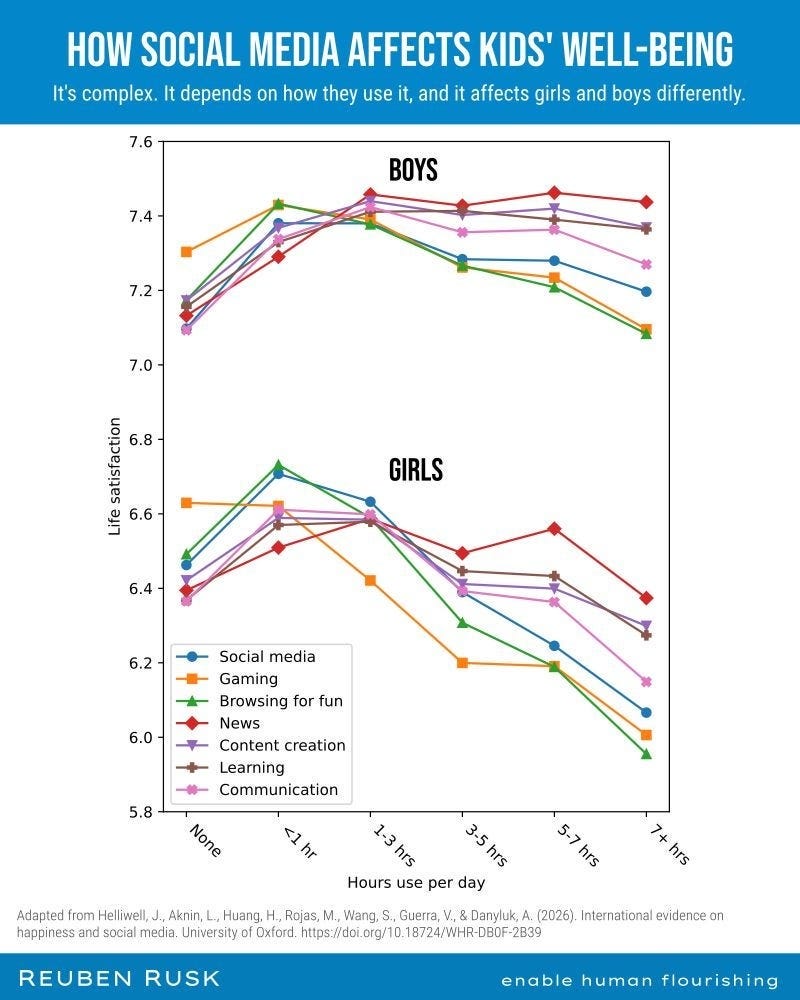
However, in the cited study, Life Satisfaction was measured on a scale of 0 to 10, not 5.8 to 7.6 as the graph represented. Who would even choose to count from 5.8 to 7.6? I redesigned the graph below to show what it should really look like if the researchers hadn’t intentionally designed it to sell the narrative.
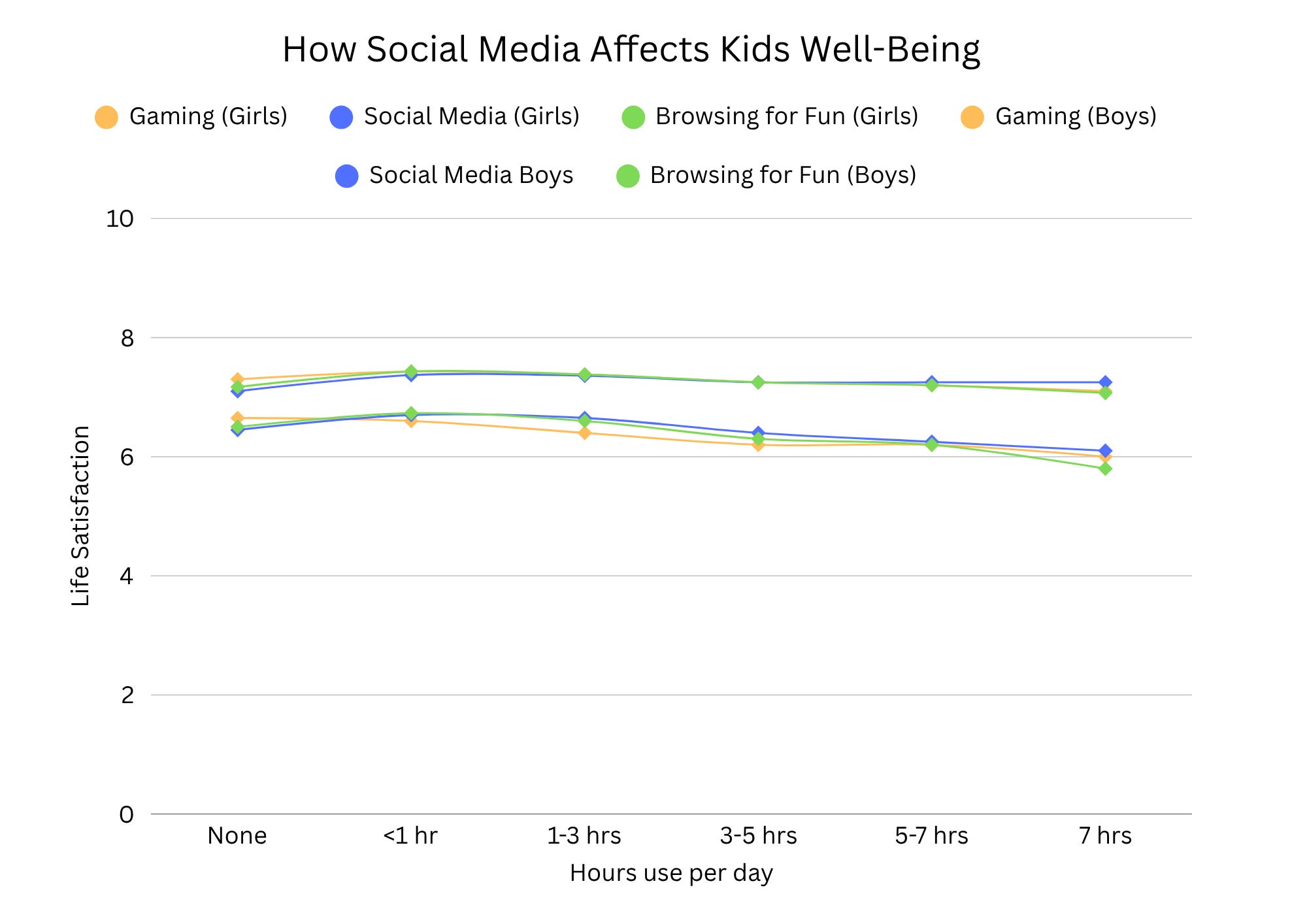
The largest drop is about 6%. So now, there really aren’t alarming findings here, but that didn’t get the clicks. The original illustration helps to sell a narrative. That is dishonest, and that’s the problem. Also, why was the original graph shared conveniently in a vertical 4:5 format? I’ll tell you. So it could be shared on social media. Yes, social media is the place where the anti-social media debate is crafted and sold.
A well-documented phenomenon in data presentation (called y-axis truncation) is starting a graph's vertical axis at a nonzero value, making even modest changes appear catastrophic. A 2021 empirical study across five experiments found that truncated y-axes cause viewers to interpret differences as far more significant than they actually are. The "truncation effect.” We can all fall for it. In the 2021 study, 83.5% of participants were susceptible, including PhD candidates in quantitative disciplines.
The Anxious Generation knew this trick very well. The book is basically a series of graphs that look to have been designed in Microsoft Word. Writing in Nature, psychologist Candice Odgers, who has studied adolescent mental health and digital technology for twenty years, observed that Haidt’s graphs showing digital technology use and mental health problems "rising together" are the kind she draws on the first day of her graduate statistics class to show students how easy it is to construct a causal story from two unrelated trend lines.
A few days ago, Christopher J Ferguson, Ph.D. shared the below image to show how correlational sensationalist data is used. It’s helpful for wrapping our heads around what is happening.
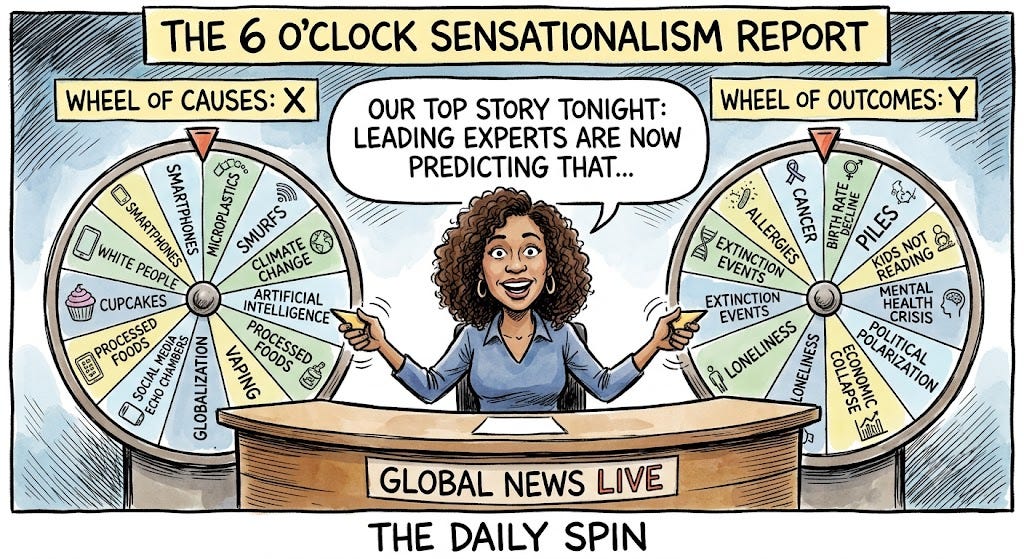
Now imagine spinning the X Wheel of Causes (on the left) and landing on “Smartphones.” Then you spin the Y Wheel of Outcomes (on the right) and land on Birthrate Decline. You could ask yourself, what would smartphones have to do with birthrates? Well, according to some graphs, everything.
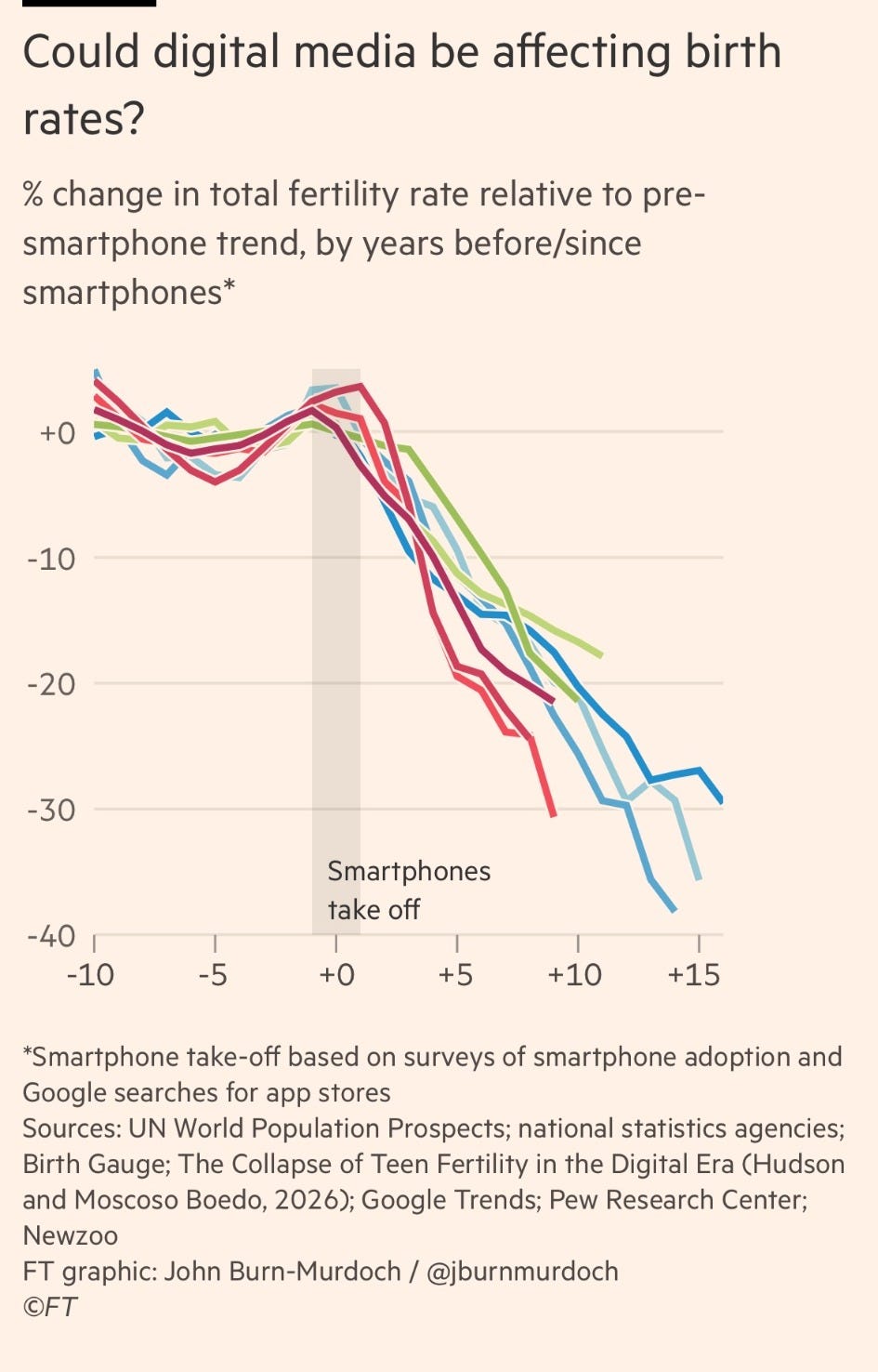
You can see how this narrative is intentionally constructed. Smartphones are bad and cause just about every concerning outcome of our time. Fertility rates have been declining since the early 1800s. But that’s inconvenient for the narrative.
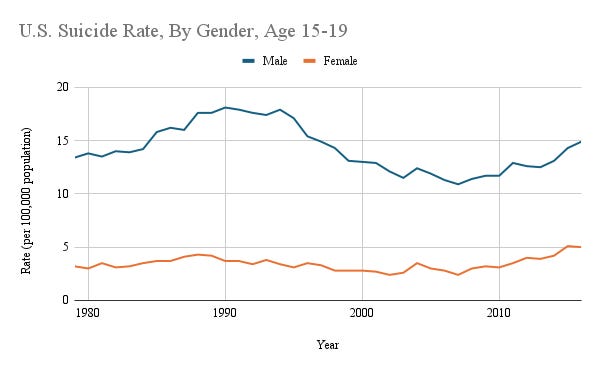
Haidt has also conducted some narrative voodoo with suicide rates, which did actually go up around the time of social media and front-facing cameras. But if you zoom out from only looking at 2010 to today, you can see the mid-2000s were actually a historic low for youth suicide. The kids in the late 1980s and early 1990s had far worse outcomes than the so-called anxious generation. This is cherry picking under the guise of science to try to strengthen the narrative.
Another analysis by Jen Lumanlan, M.S., M.Ed., noted that when Haidt describes “dramatic increases” in school alienation worldwide, he is referring to 0.2-point changes on a 4-point scale. These changes only look alarming when the graph's axis is zoomed in tight enough to make them fill the frame. The graphs used to sell this story are a form of visual rhetoric, and when combined with a compelling narrative and a receptive audience of parents who are concerned about their kids and new technology, they become illustrated fear-mongering on a new level.
Belief Perseverance
Belief perseverance is the intellectual version of painting yourself into a corner. Once caught out, some will double down even further, convincing themselves or others that they were right all along. The louder they get, even in the face of direct, opposing evidence, the stronger the cognitive bias becomes. This is the part that totally astounds me.
In Coddling, Haidt and his co-author, Greg Lukianoff, described nine common cognitive biases impacting our American society. One of them was “labeling.” Like calling all the kids the Anxious Generation. They warned us about labeling large groups of people. Lukainoff, a champion of open inquiry and freedom of speech, opposes the government restrictions and age-verification rules favored by his former co-author. Let’s add belief perseverance as another cognitive bias.
The idea is that once a person has publicly committed to a claim, the cost of being wrong shifts from epistemic (am I right?) to social (what happens to me if I admit I was wrong?). The stronger the public commitment, the thicker the paint on the floor, and the more trapped you become. Researchers have documented this under many names: confirmation bias, sunk cost fallacy, the backfire effect. We see it in politics constantly. We also see it in science.
Wilson and Kelling introduced Broken Windows Theory in a 1982 Atlantic article - not a peer-reviewed study, worth noting - arguing that visible signs of disorder signal that an area is ungoverned, inviting more serious crime. This is, of course, bullshit, but it was a compelling narrative. New York City adopted it aggressively in the 1990s, crime fell (most likely due to the latency effect of removing lead from paint and gasoline), and the theory became gospel. It spread globally. Careers, departments, and entire criminological frameworks were built on it. Researchers eventually documented that the causal evidence was never really there. Crime fell in cities that didn't adopt the approach at similar rates. A 2005 study found “no support for a simple first-order disorder-crime relationship as hypothesized by Wilson and Kelling.” But by then, the theory was institutionalized. Politically, operationally, and reputationally, the sunk cost was enormous. Admitting the foundation was shaky meant acknowledging that the harms it caused, disproportionately affecting communities of color, may not have been justified by the evidence. As noted above, the advocates’ response was to question the critics' methodology and to ignore the range of existing evidence challenging the very heart of the narrative. The data went one way. The narrative the other. Sounds familiar, right?
The trouble with painting yourself into a corner isn’t stubbornness. This approach masquerades as a misleading and unevidenced narrative of conviction. From the outside, it can look like someone who really believes in something important and pulls at the heartstrings of parents and educators. There must be a meaningful difference between holding a position because the evidence demands it and holding a position because your identity is fused to it.
When the Commissioner Knows This Wasn’t Going to Work Out Well
Australia’s Online Safety Amendment (Social Media Minimum Age) Act 2024 came into force on December 10, 2025. No matter how Haidt has joked about the ban, three months into the ban, research from the University of Newcastle surveying 408 adolescents found “insufficient evidence to conclude that the act of parliament had any effects on social media use among adolescents aged 12 to 16.” By June 2026, a Pureprofile study of over 1,000 Australians found that 78% of under-16s were still accessing banned platforms. A Reuters investigation published in July 2026 found that platforms failed to request age verification on any of 50 test accounts that simply declared a birthdate of 16. The researchers who originally advised the government’s own age-assurance trial admitted that circumvention “has become the go-to by young people.” As kids do. That’s what kids have been doing since the invention of social media. Three independent studies and Australia’s own regulator have now confirmed: the ban isn’t working, no matter what Haidt will tell you.
Even Australia’s eSafety Commissioner is “not really keen” on the under-16s social media ban. The Commissioner seemingly agreed with my previous concerns in May/June 2026 that this was drafted “very quickly” and quickly became a “very blunt approach.” AKA, not the way social policy should be enacted.
What I’ve just written asks questions. Will the ban ever work?
To that, I answer that I think there is a more important question: Should there have been a ban at all?
Getting It Wrong Is Human; Staying Wrong Is a Choice.
Getting things wrong is part of doing the science, part of being a researcher, part of being a person.
Beyond dichotomies of right or wrong, there is also agreement or disagreement. And I’m more than happy to be disagreed with, as open inquiry and discussions around disagreement can help find common ground. The history of science is a lengthy, sometimes beautiful story of getting it all wrong and correcting course. The best researchers I know wear reworked ideas like a badge of honor. That’s a true progressive research program. A research agenda that actually goes somewhere.
I believe we have a genuine responsibility to push back when being wrong causes harm or - dare I say it - misinformation. Policymakers around the world are lining up to follow Australia’s model, and bans are spreading to the UK, France, Spain, and beyond. Still, the evidence base they rest on is described by experts as “shaky,” “weak,” and, in places, “unscientific.” This is a call for epistemic courage. It’s okay that we got this wrong. Knowing it’s wrong and doing nothing about it, however, is not cool.
Haidt’s work on freedom of speech and making universities meaningful and educational again should be applauded. Haidt has also used his recent platform to stress the importance of unstructured play, risky play, and many ideas I can get behind. I tend to agree with Haidt about playgrounds, the importance of Dr. Ellen Beate Hansen Sandseter’s research, and how things became too safe for people’s own good. Haidt has also been a champion of open inquiry and viewpoint diversity, which this debate badly requires. There are many important areas where Haidt could use his platform to drive societal progress in a useful direction. It must, however, be informed by honest representations of data.
Good-enough evidence doesn’t negotiate. It doesn’t care how many books were sold, how many governments were advised, or how strongly some feel about kids’ well-being, or whether you like kids or not. If 78% of under-16s are still on banned platforms, and the research suggests the harms were never as clearly caused by social media as claimed, then there is only one intellectually honest action: update your followers and move on.
The kids, the ones both of us say we care deeply about, deserve to have us admit when we got something wrong and turn our attention back toward what the evidence actually supports: building connection, reducing structural stress, dealing with the schooling system, and giving young people the kind of real-world, embodied, relational experiences that decades of research tell us matter most.
That work is harder and slower than banning an app. It always has been.
This is a great analysis of The Anxious Generation Will! It was very insightful, and the graphs struck me the most. Thank you for this and I will be following you closely :)
This is a great analysis of The Anxious Generation Will! It was very insightful, and the graphs struck me the most. Thank you for this and I will be following you closely :)