The Psychotherapy Purity Contest (and toothpaste)
The psychotherapy purity contest, unconditional judgements of superirity, embarrassing claims, and more about the work I love.

There have always been riffs on planet psychotherapy. In the 1970s, behaviorists thought lying down to stare at the ceiling to freely associate, explore dreams, and talk about your mother was stupid, dangerous, and ineffective. Team Psychoanalysis asked why future therapists would be trained like mechanics to deliver treatment informed by Pavlov’s dogs (funny, not-so-funny story: Pavlov’s research was so impactful that he got to replicate it again… with Russian orphans). Many were arguing that psychotherapy was simply ineffective.
Then came two extraordinary contributors to the world of statistical research, Mary Smith and Gene Glass. Together, they conducted the first meta-analysis of psychotherapy outcomes - the study of studies - to try and put this scientific argument to rest. Locating 375 controlled trials, the conclusion did put one argument to rest. Psychotherapy worked and worked well. Or at least it should have.
The abstract read:
“On the average, the typical therapy client is better off than 75% of untreated individuals.”
Good news. The back half of the abstract is more telling (and wait for the quote from the end of their manuscript at the conclusion of this short piece. It’s one of my favorites.
Few important differences in effectiveness could be established among many quite different types of psychotherapy. More generally, virtually no difference in effectiveness was observed between the class of all behavioral therapies (e.g., systematic desensitization and behavior modification) and the nonbehavioral therapies (e.g., Rogerian, psychodynamic, rational-emotive, and transactional analysis).
What does the eager clinician make of such a finding? Psychotherapy works, but the stories we sell ourselves about why are not supported by the evidence.
Toothpaste
That was the 1970s. Based on some guesstimates, we had anywhere from 40 to 70 different types of psychotherapy. Today? SAMSHA has like 400, but really, if we were honest with ourselves, it’s over 1000.

More options are a good thing, right? Just look at how consumer options have flourished in your local grocery store’s toothpaste aisle. Yes, there are some common brand names like Crest (the behaviorists) or Colgate (the Freudians), but we also have Sensodyne and organic types as well.
Crest has Crest 3D White, Crest Pro-Health, Crest Gum, Crest Sensitivity, Crest Enamel/Densify, Crest Kids & Baby, etc. There is also daytime and nighttime toothpastes. The behaviorists have CBT, ACT, DBT, REBT, Systematic Desensitization, ABA. Just to name a few.
We have Colgate Total, Colgate Optic White, Colgate Kids, Colgate Sensitive Pro-Relief, Colgate White Stain Fighter Enamel Care 1% Hydrogen Peroxide, and Colgate Advanced Whitening Tartar Control Toothpaste. Stemming from Freud’s psychoanalysis, we also have psychodynamic psychotherapy, brief psychodynamic therapy, intensive short-term dynamic psychotherapy (ISTDP), transference-focused psychotherapy (TFP), supportive-expressive psychotherapy, and time-limited dynamic psychotherapy (TLDP).
The great news is, being a professional community of evidence-informed scholars and clinicians, we listened to Smith and Glass’ (1977) warning and went back to the drawing board asking how psychotherapy really worked.
Joking of course.
We kept making new ones, and people kept believing their toothpaste was more “real” than every other toothpaste selling basically the exact same shit.
Half a century later, however, it all paid off. Joking again. Psychotherapy outcomes have not improved since our first landmark meta-analysis.
The Only Real Psychotherapy
Since joining Substack, I’ve tried to take notes of mentions of “real” psychotherapy. Whenever I hear this term, I ask myself, if we knew what “real” psychotherapy is, wouldn’t something get better? Or do only charismatic leaders who write the books and sell the trainings know what “real” psychotherapy is?
I asked someone last week if by real psychotherapy, they just meant psychoanalysis. They said, “Yes.” I then asked, “What about something like an existential psychotherapy?” That was ok too, based on their gatekeeping. But anything with an acronym was referred to as a brand and not a real psychotherapy.
I guess ISTDP, the intensive short-term dynamic psychotherapy, doesn’t count by this logic.
I wonder what it would take for them to pick up a different toothpaste that seems to make as meaningless a difference to psychotherapy outcomes as the one they’re currently using.
What really matters?
Psychodynamic therapies, CBT, DBT, SFBT, Motivational Interviewing - the list goes on - tend to produce broadly equivalent outcomes when compared in clinical trials (we know this, Smith and Glass found this in 1977…)
That doesn’t mean all therapies are identical. It means the variance in outcomes is not primarily driven by the specific techniques unique to each model. This includes eye-movements in EMDR. Remove the eye movements? No difference in outcomes.
You can literally remove the technique people claim to be most important to a therapy and change very little in regards to outcome. It’s quite remarkable actually.
So when someone insists that psychoanalysis is the only therapy that goes “deep,” we have to ask: deeper than what, exactly? And according to which data?
Psychoanalytic and dynamic informed-therapies absolutely help some people. So does CBT. So does DBT. So does ACT. So does SFBT. Psychoanalysis is more than a century old and it’s here to stay. Therapies don’t really ever dissappear, or evolve that much, for that matter.
Just think if you have a video recording of Freud and then of Rogers, and then of Marsha Linehan, and then of your work today. You watch it, but on mute. Clients can sit up and maybe there’ll be some eye movements or tapping. Other than that, therapy looks exactly the same as it did 100 years ago. Ask yourself, what about dentistry, surgery, cancer treatment, etc.?
The research simply doesn’t support the claim that one of these approaches is universally superior. In fact, large-scale comparisons typically show negligible differences in overall effectiveness across established therapies.
This is where the debate starts to feel a bit . . . performative.
Calling acronymed therapies “brands” while positioning psychoanalysis as the sole authentic psychotherapy is less a scientific claim and more a cultural stance. It’s an identity. A tribe. And social media rewards tribes. Bold declarations travel further than nuanced evidence.
But when we elevate one model as the only “real” therapy without robust comparative proof, we drift into something resembling elitism. I’ve seen it myself. I wrote a solution-focused book about my outdoor therapy practice and was told I wasn’t solution-focused enough. Not joking.
If we believe the story we tell ourselves about our “real” psychotherapy void of the evidence, we risk telling potential clients that unless they can access a particular (often expensive and long-term) form of treatment, they’re not doing “real” work.
That’s not just unhelpful—it’s irresponsible. I’ve heard this said about why psychoanalysis is better than CBT, but we can’t prove it because we don’t have long enough clinical trials. To me, that translates to, “I think it’s better but I have no proof or evidence to support this claim, but trust me, the real work begins session 20.”
Avoiding the Psychotherapy Purity Contest
Therapy is not a loyalty program. It’s not about pledging allegiance to Freud or to the latest manualized intervention. It’s about what helps this person, sitting in this room, at this time in their life.
In my own clinical work, I’ve seen time and again that it’s the quality of connection, not the theoretical purity, that moves the needle. A strong alliance can make structured approaches transformative. A weak alliance can render even the most “depth-oriented” psychotherapy inert.
We should absolutely debate ideas. We should critique weak evidence and challenge overblown claims. But if the conversation becomes “my therapy is real and yours is just marketing,” we’ve lost sight of the point.
The point is that our services are meaningful to those sitting across from us.
And the data, imperfect as it is, suggests that empathy, collaboration, and hope matter far more than whether the therapy has an acronym…or was born in Vienna.
Maybe the most important toothpaste is the one that inspires a person to engage in brushing their teeth.
Top 5 Fav Pieces of Writing
And here it is to conclude, “Unconditional judgments of superiority of one type or another of psychotherapy, and all that these claims imply about treatment and training policy, are unjustified. Scholars and clinicians are in the rather embarrassing position of knowing less than has been proven, because knowledge, atomized and sprayed across the vast landscape of journals, books, and reports, has not been acceessible” (Smith & Glass, 1977, p. 760).
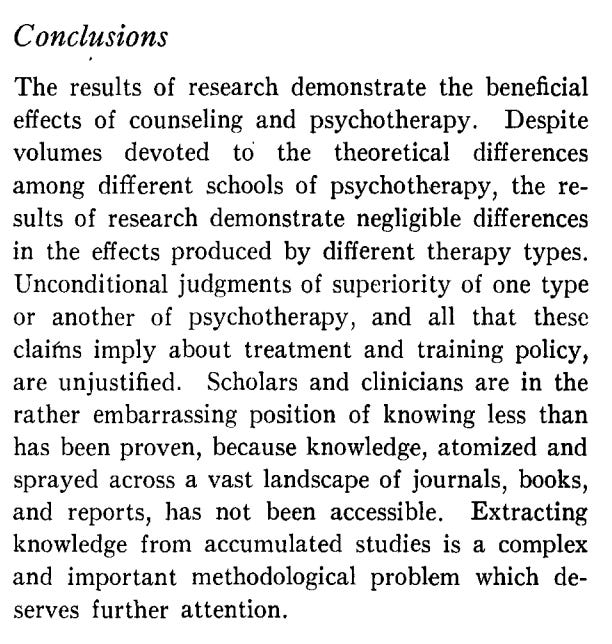
So far we don’t have a single robustly examined therapy that produces outcomes superior to empathetic support alone.
Even more embarrassingly, we don’t have evidence that qualifications or years of experience of the therapist influence outcomes either.
Psychotherapy would improve in effectiveness rapidly if they'd just stop with the talking DO something.